Today is National Siblings Day. Isn’t Every Day? Okay, Maybe Not.

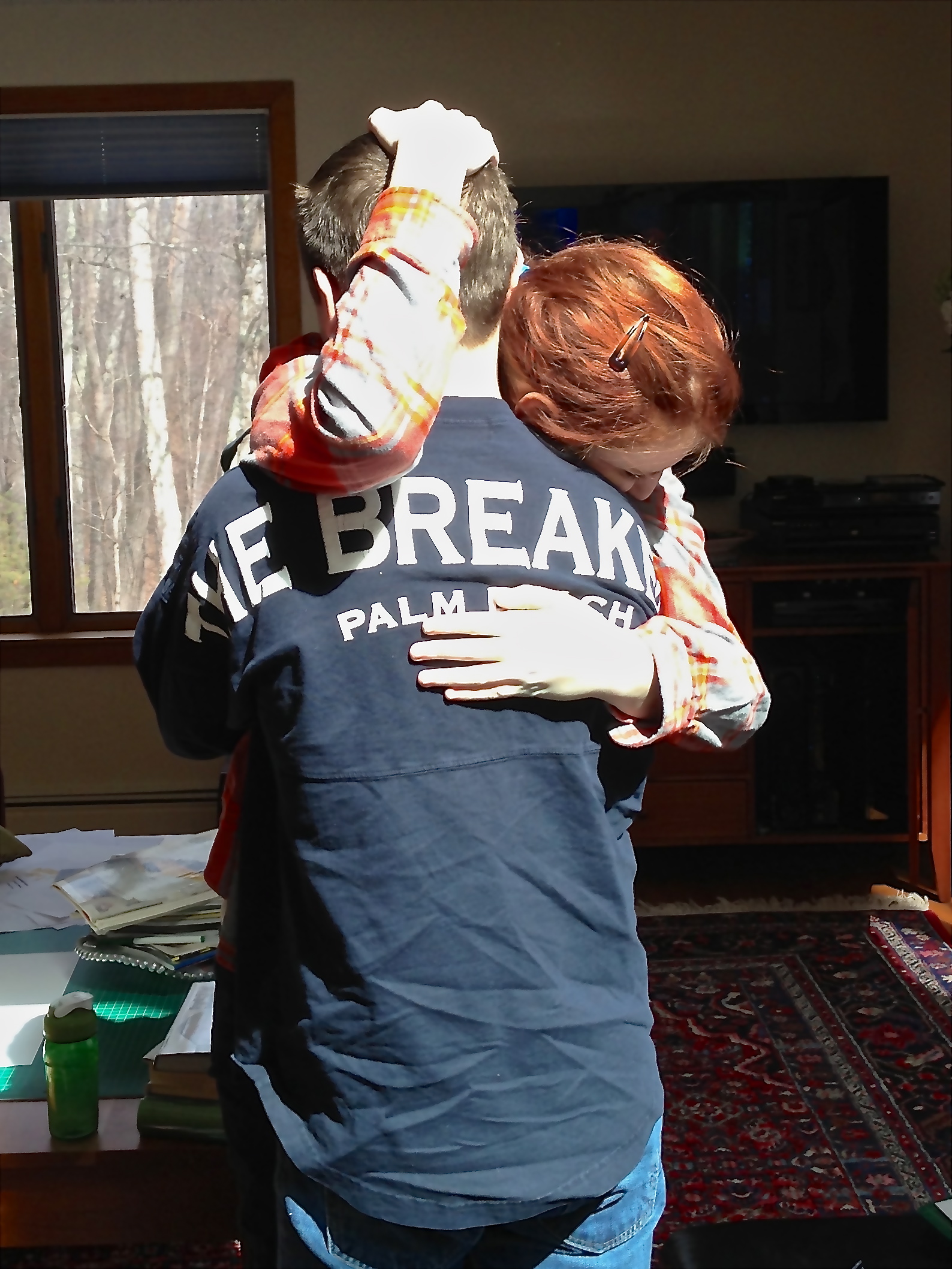
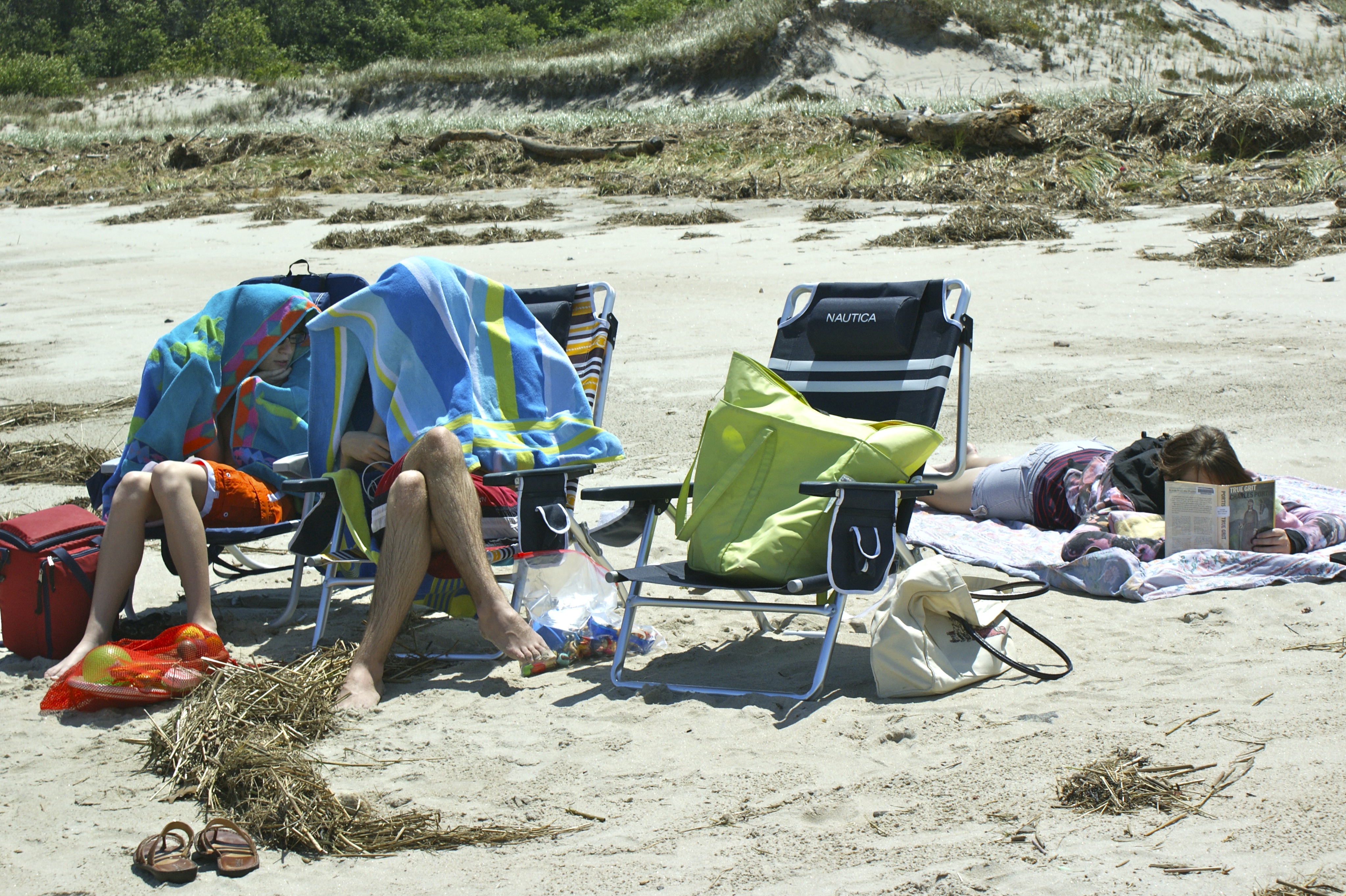
SONY DSCWho thought this day up? Hallmark? Well, it’s a good excuse to sift through the photos, and it’s amazing how hard it is to find a photo that includes everyone that captures the spirit of our brood and still preserves some privacy. I think I found it.

Siblings of autistic children don’t have it easy, and we do our best to recognize their challenges and build some rewards into the process of accommodating the necessary quirks of life with autism. Remember my movie post earlier this week? Access to movies, screens and electronic devices like iPods is exponentially greater in our house than it would have been without autism (I think). We’ve made more trips to the beach, given more nods to everyone’s food preference (a special diet for one person demands more flexibility for everyone, sometimes), and we’ve tried, not always successfully, to give everyone the spotlight at time when they wanted it (sometimes they don’t).

The hardest thing so far is giving each child space from the others when they need it to create their own identity. Sometimes it’s difficult for ASD people with a developmental delay or cognitive impairment to see a younger child grow past them, as it were. And siblings are not always diplomatic in creating the separation that’s necessary for them to grow up. It’s hard to do and hard to watch; everyone involved experiences frustration, anger and hurt. It’s typical for all families to go through this, but as parents it is much harder to keep ourselves from intervening than we expected – we are so invested in the idea of inclusion that we have to remind ourselves that our children need to prepare for a life apart from each other. If we give them the space they need now, we hope the bonds they forged when they were young will stay strong after the angst of adolescence has passed. That’s the idea, anyway.

Rocking Autism Awareness

Objects in mirror may be closer than they appear

Objects in mirror are closer than they appear

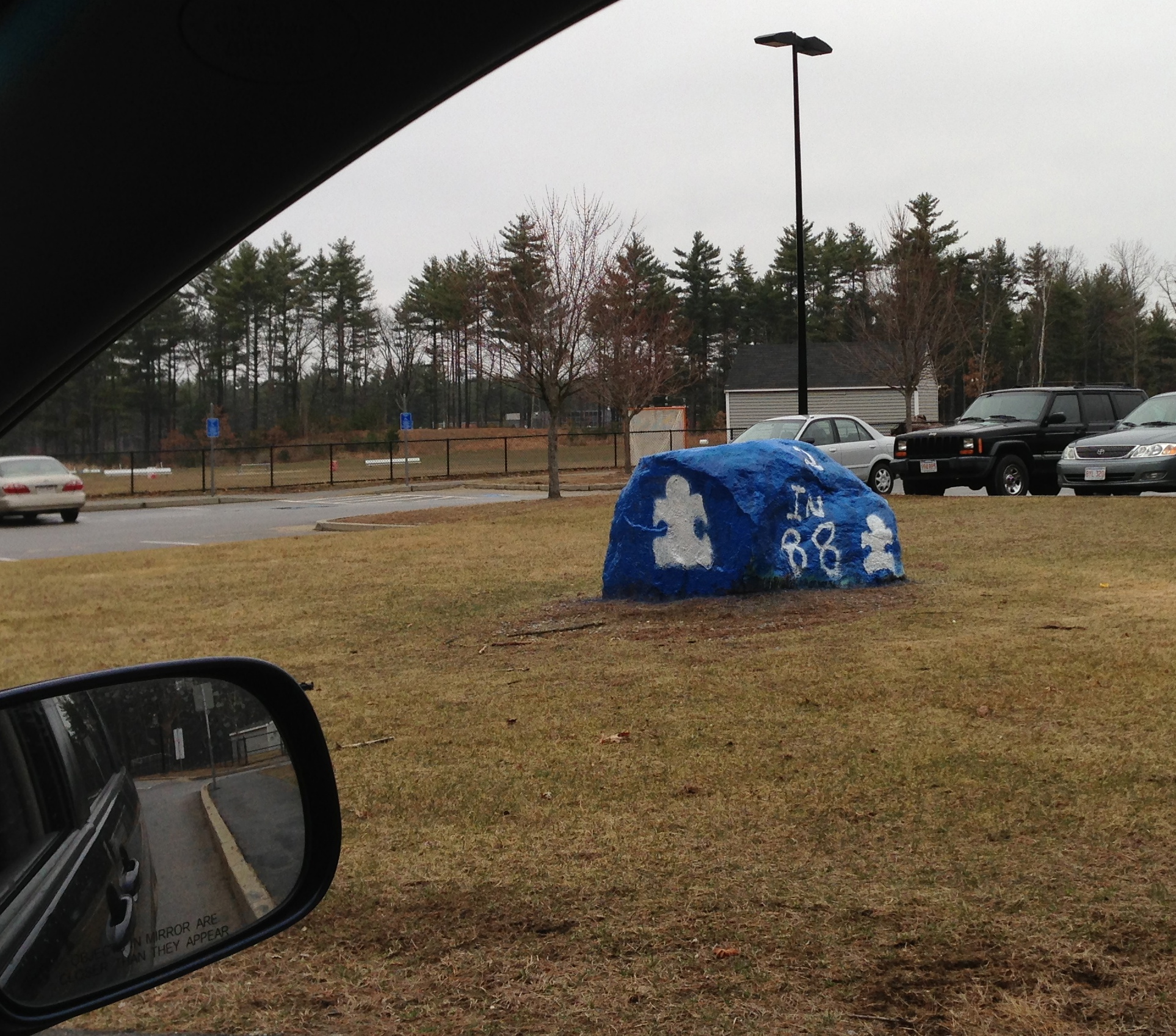
Many high schools in our area have a big rock on which students advertise the latest fad, inside joke, or activity. They scamper in after hours and paint the rock, and this week some of our enterprising seniors painted it up blue. It’s touching. Still, all I can hear in my head is the voice of Charlie Brown on Halloween night as he looked in what was supposed to have been his bag of candy and moaned, “I got a rock.”

25+ Movies and Shows that Pass the Tests of Time, Patience, and Scripting – and 10+ that Don’t

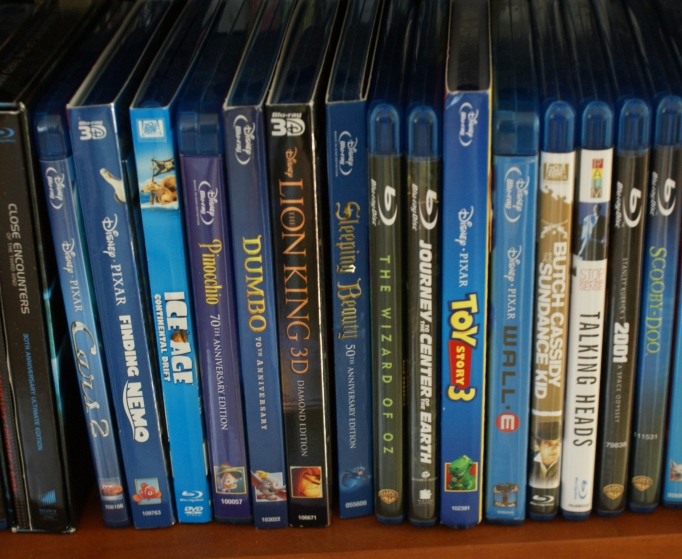
Yes, we have a lot of movies.

Yes, we have a lot of movies.

In a nod to the late Roger Ebert, I’ve assembled a list of movies and shows that can endure the repeated watching that results with having an ASD person in the family. This list is highly personalized – you may find the movies I love are the ones you can’t  stand – still, I’ve tried to give a quick rationale for why I like or dislike each one. There is one universal truth: if you expose ASD kids to inappropriate language, they will repeat it – in public and loudly. SpongeBob Squarepants deserves a post all to itself. You’ll have to wait for that one. The Same goes for Finding Nemo. The jury is still out on Scooby Doo.

Do

All of the Scholastic/Weston Woods videos of classic books like Goodnight Gorilla, A Story A Story and Strega Nona

Having the paper books available and turning on the subtitles for each story clearly bolstered our boy’s verbal and sight reading skills.

Sesame Street/The Muppet Show/Muppet Movies

Inexplicably, we go through pro and anti-muppet phases and continue to have lengthy discussions about the “realness” of Muppets. The Muppets are also very useful in teaching about humor and jokes like puns – ASD kids seem to read the social cues of muppets better than in actual people.

Richard Scarry’s Busytown/Busy People

Lovely music and great ways to learn alphabets, rhyming and counting. Also good to have these books handy for reading/storytelling skills.

Dumbo

So many people think this movie is too sad, but there is no greater depiction of the mother-baby connection in animated film. The pink elephants and the crows are also objectionable to some people, but that Casey Junior Train is an icon that endures. It’s what inspired the artist in our boy. For years he would set paper, crayons and paint in front of me and make me (and his teachers) draw it over and over – and then one day he did it himself.

Kipper

His Kipper scripting was so spot-on that everyone at the local pool thought he was British. I could watch this forever. I may have to.

Wallace & Gromit/Shaun the Sheep

Hilarious. A Close Shave is a little scary, FYI. Shaun is a tiny non-verbal sheep – our boy identified strongly with him.

Thomas the Tank Engine/Thomas and the Magic Railroad

The older the better – Ringo, James Carlin and Alec Baldwin if you can find them. At one point I wrote to Baldwin telling him he should make videos as Mr. Conductor in which he eats a variety of foods to model good eating habits – the single act of eating celery and carrots in the Magic Railroad movie changed our lives. No, he didn’t write back.

Cars

The themes seem to resonate – loyalty, frustration, friendship, racing. Skip the second one.

The Wizard of Oz

Our boy’s favorite song: If I Only Had a Brain. Do not, under any circumstances, see Oz the Great and Powerful.

The Sound of Music

My favorite story about this movie: when we were doing cognitive testing, the examiner asked our boy who discovered America and the answer our boy gave him was, “Christopher Plummer.” Also, he drew the cathedral wedding scene using the characters from Scooby Doo.

The Polar Express

No explanation needed. Later this year I’ll do a more detailed post on Christmas viewing.

Live action Peter Pan (2003)

The Disney version pales in comparison to this visually stunning, complex version, in which Jason Issacs’ Hook is the perfect villain with a sympathetic edge. Old, alone, done for.

Chitty Chitty Bang Bang

Truly scrumptious. The child catcher scared the hell out of me when I was a kid, but made zero impact on my kids. Go figure.

The Lion King

I didn’t want to add it to the list, but I had to. It’s the Elton John/Nathan Lane/Jeremy Irons factor.

The Road to Eldorado

Totally underrated – visually stunning with dialogue and songs well worth repeating.

The Emperor’s New Groove

Boom, baby! The incomparable Eartha Kitt. Kronk and his own theme music. Possibly the highlight of David Spade’s career.

Hercules

Pegasus. Excellent soundtrack.

Toy Story

All of them – he literally grew up with them, and Andy’s going off to college is the best story we have yet on transition issues.

Looney Tunes

We did have to hide this one for awhile because his standard response to everything became “Beep! Beep!” but it’s back in circulation now. We simply cannot live without Wile E. Coyote, super genius.

What’s Up Doc?

Yes, Eunice. Our boy dressed as Howard Bannister regularly for months. Possibly my favorite movie ever.

Raiders of the Lost Ark and Indiana Jones and the Last Crusade

These are great – skip the other two.

Don’t

Up

I don’t know anyone who was not destroyed by the first 20 minutes of this movie – it actually triggered such anxiety in our boy that we had to see professional help.

Ice Age

Sorry, Scrat. No redeeming dialogue or plots, and scripted speech from Sid the Sloth is really, really bad.

Jurassic Park

We couldn’t really avoid it, and it really is a good movie but: too much screaming! Also, the only curse word our boy uses is a perfect imitation of Samuel L. Jackson’s “Damn!”

The Sword and the Stone

Yes, Merlin is a hoot, but if I hear “I’ve had enough of this nonsense!!” one more time I will blow myself to Bermuda.

Cinderella

Lucifer the cat was the bane of my existence for years. Too much meanness.

Beauty and the Beast

Gaston and the angry mob bring out all the worst qualities of scripted speech.

The Wolfman

We canceled our premium cable channels after he stumbled on this and became obsessed by both the sex scene and the transformation from man to beast. It did help us communicate at a  key point in his development because we realized that references to the Wolfman occurred when he experienced digestive pain.

Both lists could go on forever, but these are the ones that come to mind without a trip to the movie shelf. If you’ve found anything good, helpful or just fun for older kids and teens please post a comment – we are always looking for more adult content that is not too adult, in terms of language, sex and violence.

Ten Years On: Revisiting the Magic Pebble

This is an essay I wrote before blogging was invented, composed for someone who was our first magic pebble. I posted it a few years ago on LettersHead, but here is clearly where it belongs. This is for you, K.

We used to read William Steig’s Sylvester and the Magic Pebble every night.  It’s the story of Sylvester Duncan, a young donkey that finds a magic red pebble, and, faced with a fierce lion on his way home, Sylvester panics and turns himself into a rock.  His frantic parents look all over for him, but give up in despair after a month of searching.  They are reunited a year later when his parents lay out a picnic on the rock that is Sylvester, and happen to find the red pebble and put it on the rock.  Sylvester wishes successfully to be himself again and they all go on happily with their lives, saving the pebble for a time when they may need something more than to be together as a family.

Whenever I read this story to our children, I find myself identifying with various characters in the story.  On some days, I am the mother and W. is Sylvester, hidden in the stone of autism, wanting to get out but locked in the by the spell of the pebble.  We are Mr. and Mrs. Duncan, haplessly eating lunch on the rock, wondering how we can possibly go on with our lives when the fate of our son is such a complete mystery to us.  On some nights, the story in my head ended there, with W. still trapped inside the rock.

There are more dramatic versions.  There’s the Harry Potter version where Sylvester the Dobby rock starts hurling itself around, crashing into people and things, a possessed bludger that no petrifying spell can stop.  The wayward rock eventually wears itself out, but only after leaving most of the Duncans’ town of Oatsdale beaten and bewildered.  Mr. and Mrs. Duncan split a bottle of dandelion wine and dream of summer on the beach.

Occasionally, I am Sylvester, trapped inside the rock, wondering how I got there and wanting only to sleep to forget how I got myself into such a spot.  The world moves around me, the people and seasons come and go but because I am a rock and I don’t look like myself no one knows I am there.  I am inches from the magic pebble that will set me free, but I am helpless to touch it or even be sure that it is there.  My parents are gone.  I cannot be rescued the way Sylvester was; there is no one to rejoice over my return so perhaps it doesn’t matter whether I am a rock or not.  But just as I warm to my mid-life crisis, I am touched by my magic pebble – it is W., reaching with two fingers to push up the sides of my mouth to make me smile.  And it is M., with a smooch that could bring the hardest granite to life.  And A., too, working her own magic just by reading her own book on the floor next to us.

And there are magic pebble days, days in which someone or something brings our beloved W. back to us.  On these days the story ends just as it should; the boy I see and the person he is inside are one and the same and we inhabit the same world.  The magic is the love we share, in his friends, in the water and sand of the beach, and in the people who work so hard to make the world understandable to him and to make him understandable to us.  These are the best days of all, and as the years go by there are more and more of them, and that is a miracle I don’t need a book to help me understand.

Finding Inspiration in the Life of Roger Ebert

IMG_3671“‘Kindness’ covers all of my political beliefs. No need to spell them out. I believe that if, at the end, according to our abilities, we have done something to make others a little happier, and something to make ourselves a little happier, that is about the best we can do. To make others less happy is a crime. To make ourselves unhappy is where all crime starts. We must try to contribute joy to the world. That is true no matter what our problems, our health, our circumstances. We must try. I didn’t always know this and am happy I lived long enough to find it out.”

– Roger Ebert

Roger Ebert died today. I loved watching Siskel and Ebert, and even though I found myself agreeing with Gene Siskel more on serious films (my first movie critic love was Pauline Kael – I read all of her books and wrote a paper on her in high school), when Ebert said a movie was delightful I knew it was worth watching. When I got around to reading his reviews instead of watching him on TV, I liked him even more. Finally, the grace and bravery with which he handled his disabilities at the hands of cancer made him a hero. By that time (2006) I was trolling for examples of what people did when life threw them a curve. So many people withdraw from public life when faced with that kind of adversity, but he understood, used and took solace in the healing power of the written word. When we visited Chicago in October 2011, the only souvenir I brought back was a signed first edition of his memoir, Life Itself.

We take inspiration where we find it, which means it is important to raise our heads sometimes and take in the world free from the lens of autism. What better way to do that than watch movies, which can transport us to times and places far beyond our oft-constripted world. When I am looking for  a good movie – new or old – my first stop is the great movies page on rogerebert.com. You don’t have to read Robert Ebert to admire him, but if you need inspiration, there is a lot to choose from.

Pick a movie, any movie.

Putting Autism in its Place

Written by me on my non-autism blog. Clearly, I’m not that good at compartmentalization.

LettersHead's avatarLettersHead

Autism Acceptance Month includes Light it Up Blue day, and people find themselves reminded, pummeled and delighted by blue lights everywhere. It’s hard to know how to feel about the hoopla when we try so hard not to let autism dominate our lives. That’s why I moved my autism posts to their own blog. To be honest, though, those were the posts that got the most hits when I began writing Lettershead back in 2009. Much as it would lovely to be vastly popular and widely read, Lettershead is about trying to keep some perspective and focus on ideas that are not directly informed by autism.

Autism casts a long, blue shadow, however. Sometimes it feels like I spent my early years escaping the shadow of alcoholism only to turn and face autism. It was good preparation, as it turns out. An anxious person by nature, living with…

View original post 510 more words

Light it Up Blue: sometimes the reflection is brighter and more beautiful than the flame itself

Our blue light

Our blue light

As I angled the camera to get a good photo of the blue candle, I saw that the reflected flame is more beautiful than the original. With all the talk of Holland* and dashed hopes that some of us face with an autism diagnosis, with all the planning and worrying still to come, with all the explaining and misunderstanding and misinformation in the world out there, with all the emotional collateral damage yet to assess, there is still a light that shines in the darkness of what my life would have been without him (and his siblings, who show such tremendous grace and humor under pressure). As much as ever, I embrace what I wrote in 1998 when I tried to describe what turned out to be autism: this boy is closer to heaven and hell than I will ever be on this earth. His unfiltered (or sometimes, overfiltered…) take on the world reveals the sublime and the absurd and gives me the courage to keep fighting demons that, without my children, surely would have overtaken me long ago.

But I know the roles can reverse. There are many who justifiably curse the cloak of darkness that autism drapes over their child. It’s impossible to be grateful for every moment; there are millions of them that are best forgotten. But it’s in those dark moments that we are most grateful for the light when it does return (if we can just remember where we hid the matches).

***

*The Welcome to Holland essay inspires many people when they first face a disability diagnosis, but Susan Rzucidlo’s Welcome to Beirut has always been my personal favorite for families on the spectrum.

Easter Monday, April Fools’ Day, Autism Awareness Month. The Mind Reels.

SONY DSC

Renewal and irony and reality all converging on a single spring day. Melting snow, green shoots, black earth. The extremes of New England’s seasons are the metaphor I cannot ignore.

I tend to roll my eyes on the awareness month for anything, and even more so for Autism Awareness Month because I’m conflicted about foisting upon the world an awareness of what I consider to be our private business. But making the world more navigable for our boy is part of that business and thus I need to try to find ways to use the opportunity that autism awareness month presents without seeming insufferable and needy (good luck with that, I know). And what is a blog for if not for saying something that I think might be worth reading? I ask myself all the time why I do this and most of the time the answer is that I write about it because I can’t not write about it. From my perch, autism awareness is as much about the journey and the humor and poetry borne of the angst and the crazy – it’s not nearly as helpful as what others are contributing to the dialogue, but it’s what I have.

So in a nod to the everyday awareness that we have of autism, I’ll post something every day (an essay, photo, or link to those who are saying it better than I) in April in hopes that something and interesting and good will come of it.

Today, John Elder Robison continues to fight the good fight for people with Asperger’s Syndrome in the wake of Sandy Hook.