The Pre-Tromp Romp

Now is a good time to note that, however camp turns out, we have learned and grown enough in the last two weeks to make it worth it. From a delightful and heartwarming exchange with the creators of Hoops & Yoyo to the deepest conversations ever with our boy about growing up and what camp is for, we have already made great strides. We have packed a summer’s worth of activity into one week and watching our growing children do the same things they always have shows us how much they have grown physically and emotionally. So, for a moment, we smile and breathe easier, understanding that we were a little better equipped for change than we thought. Hearts full, fingers crossed – here we go.

Photo: a parade of sparklers.

Mother’s Day: Instant Respect!

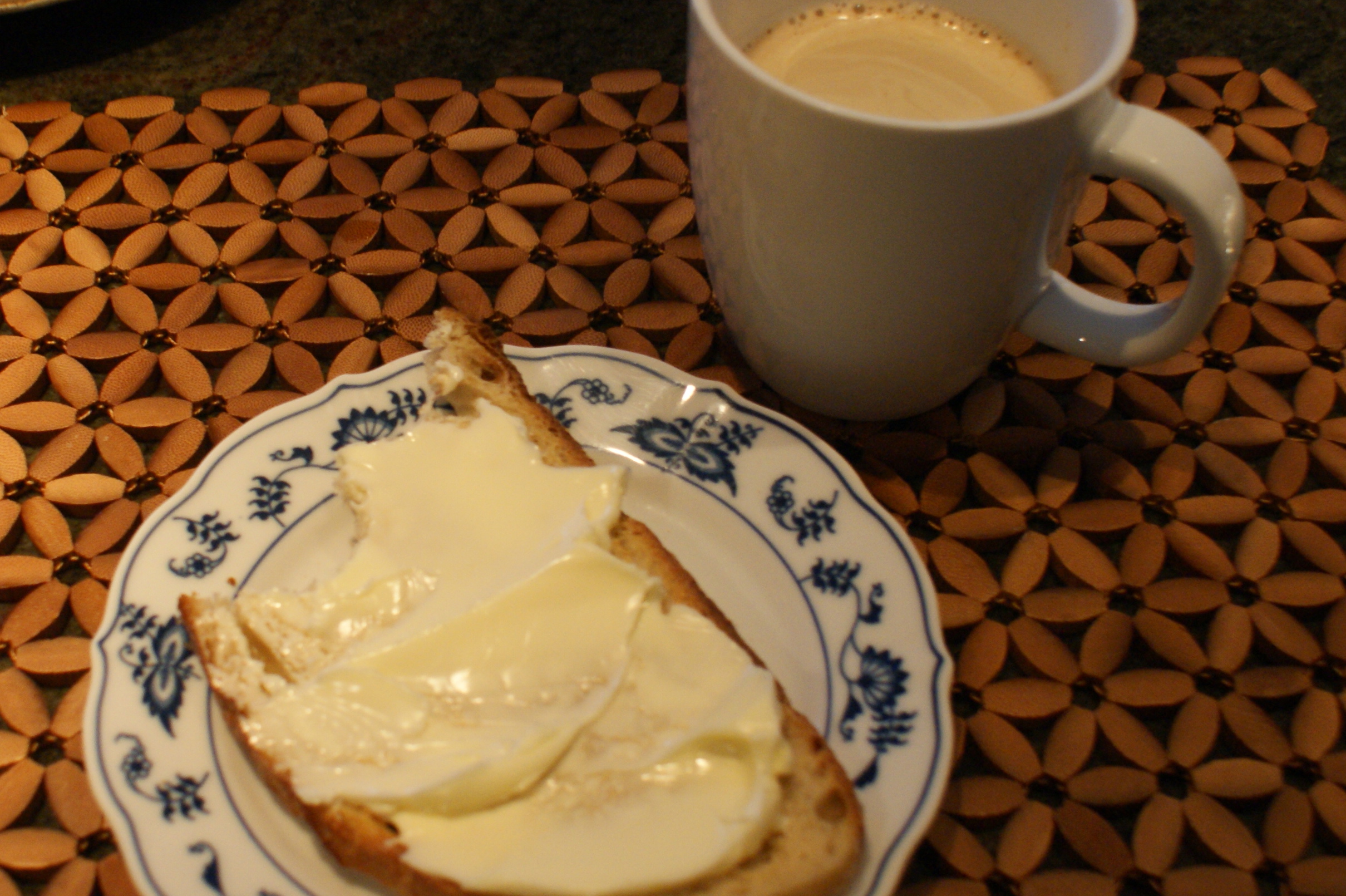
Any holiday that results in the world being filled with flowers and slightly burnt toast can’t be all that bad. Our mother told me that some of the best days of her life as a mother were when her own children had kids of their own and felt the weight of responsibility that comes with holding a newborn.  She paused for emphasis and raised her hand with a flourish and proclaimed: “Instant respect!!” And she treated all of us like people all the time – no talking down – never really couching her guilt trips (there were many; they can be useful) in a way that diminished motherhood itself.

A feminist who disdained the very word, she understood the power of matriarchy and wielded its grandly. And her belief that children are gifts from God, given to us to teach us about ourselves as part of a the pursuit of the divine was probably her greatest lesson to me. She believed in everyone having a divine purpose and often said that pride was her biggest obstacle to pursuing the path laid out for her. I get that.

Mom said she had to remind herself that she could neither control nor shape the fates of her children (though that really didn’t stop her from trying) but the more powerful thing she said was that her belief in divine providence reminded her that she could neither take credit for our successes nor blame for our mistakes. And while there were times I thought that statement was a cop out, I can see how she thought that when I look at my own children; I don’t know that much more about them today than I learned in the first 24 hours in the hospital after each of them was born. They have all been so much themselves from the very first moment we met, and yes, I factored in the autism. Certainly we must give them all the tools we can to release the full potential they have; to keep them healthy and safe but most of all to help them know and understand the power and meaning of love.  It sounds simple and it’s pretty straightforward until you have that moment as a mother where the greatest love means letting go.


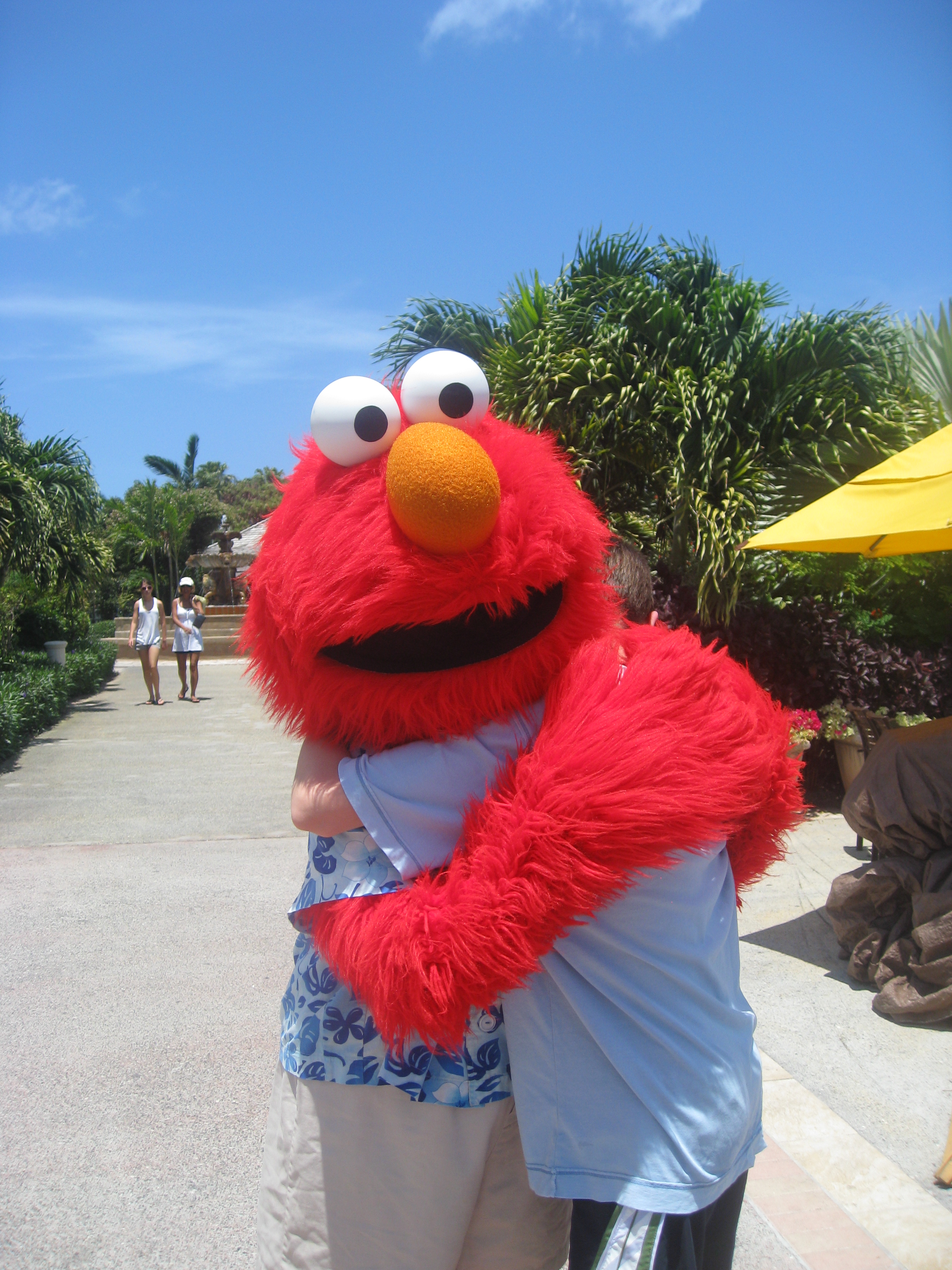
Hug Me Elmo.

This is from a couple of years ago and it is a sweet photo but at this moment it is an example of all I want to overcome.  Now, suddenly, as adulthood looms for real, the endearing photo of a birthday hug from Elmo only tells me that we need to do more to make the adult world accessible and palatable – no, joyful – to our boy.  Adulthood is daunting to all of us, so how do we differentiate childlike from childish, nurturing from insulation, love from coddling, wisdom from denial, bravery from cruelty?  The lines between all of these things shift on me, all day, every day.

You’re a Pretty Cute Kid but Your Feet Don’t Match

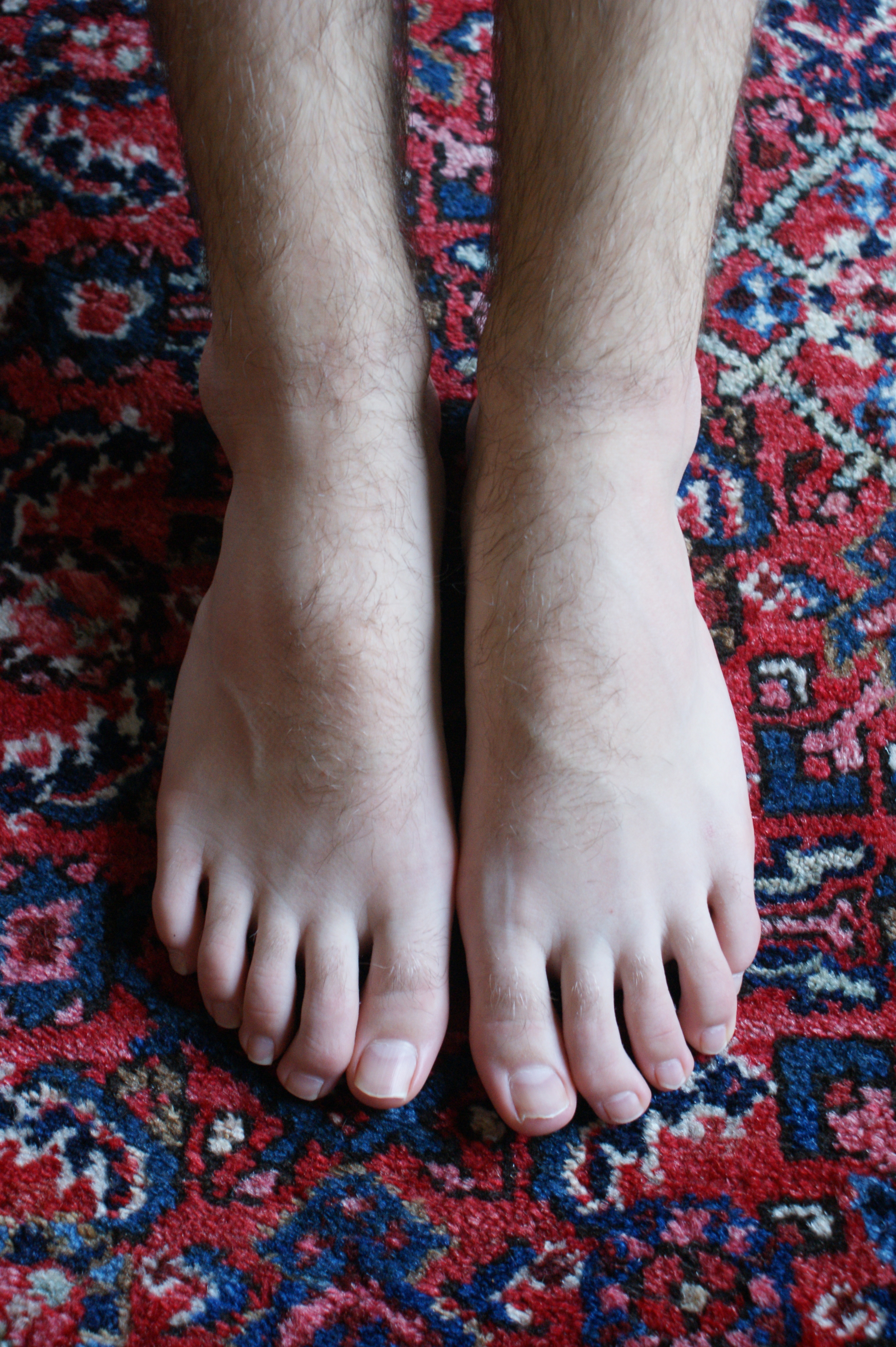
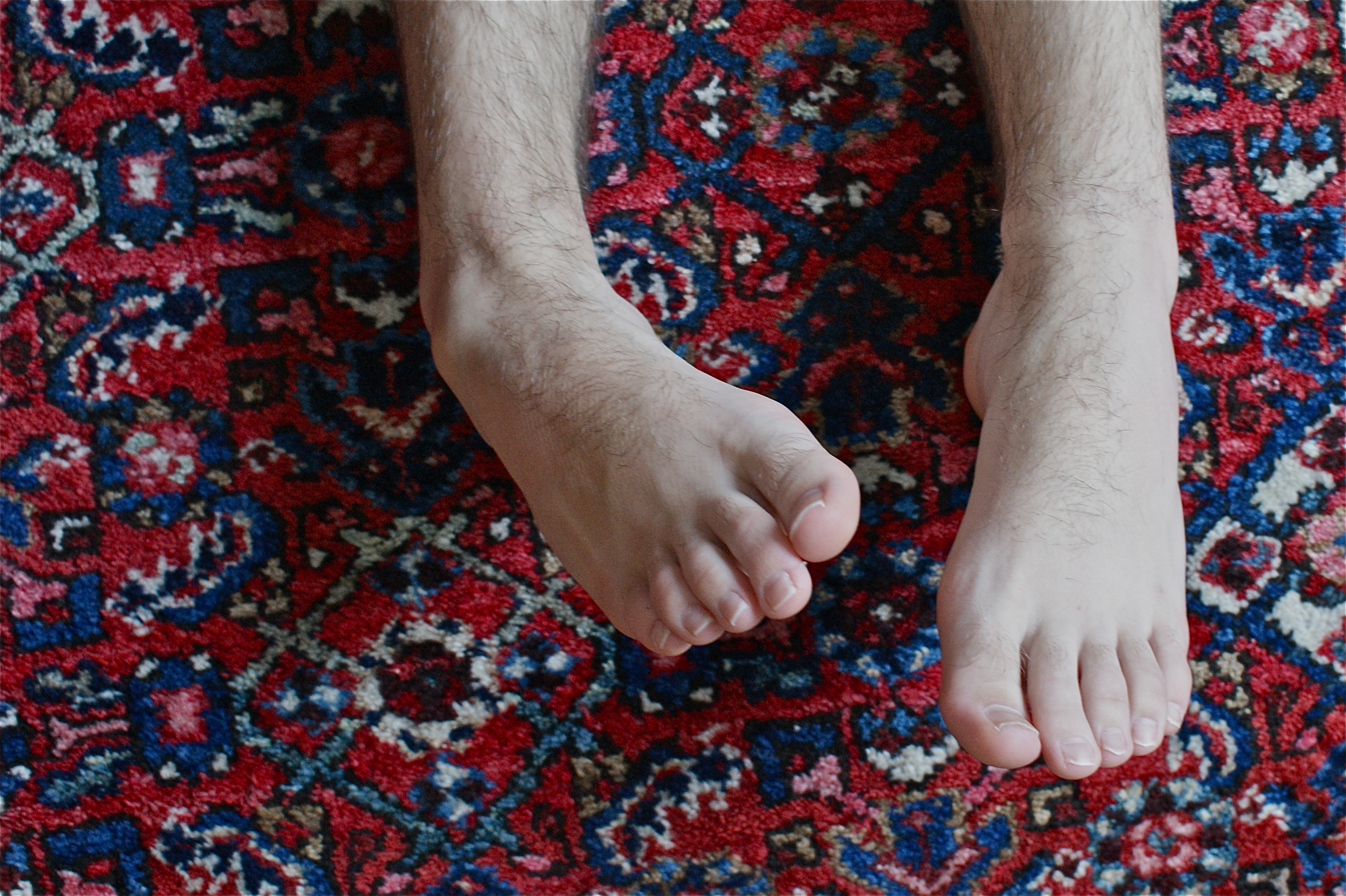
That’s what my Dad used to say to me all the time.  The first time he said it I was very small and absolutely horrified, and I heatedly insisted that my feed DID match.  Then he took my tiny toes in his hands and pointed out that my big toes were on different sides and that if my feet truly matched they would look exactly the same.  Stubborn as I was, I did not like to be teased in this way and for a long time I scowled at him every time he said it.  The older I got it became progressively more annoying until – poof! – it it became endearing, one of many stock phrases he could be counted to toss out in the course of a day. And eventually I started saying it to my own kids, and they find me annoying.   Surprise.

Last Sunday morning it came to mind when my boy padded into my room and slipped into bed with me, taking up the spot usually occupied by his traveling Dad.  As I snoozed on my right side, he lay on his left side playing with his iPod, and he lined up his feet so that the soles of his matched up with the soles of mine.  An excellent case of respecting personal space with me, as I jealously guard the few weekend mornings when I can sleep in.

I used to think more than I should have about the matching feet thing – it took me longer than usual to grasp the concept of symmetry, I guess.  It bothered me when I was little, because I was the youngest and hardly ever in on the joke and thus took everything so literally (case in point: I thought the guerillas who terrorized the Olympic village in 1972 were men in gorilla suits). Sometimes I still miss the cues and can be gullible, which makes me love living with this boy even more because his syntax and receptive language are all over the place – it can be hard to know when he is being silly and when he is earnest.  He relies quite heavily on scripted speech and so some of the mashups that come out are priceless.  A few weeks ago after being rude and subsequently scolded he asked, “Did my popping off cook my goose?”  The latest favorite happened when he got into the car after a long bike ride with a friend:  “Man!  I have a splitting butt ache!!”

Our feet might not match, but I think we understand symmetry.  And, unlike his mother, he has very nice feet.

It’s April Vacation – let’s have a fight about The Mom Thing.

Thanks again cable news for the sideshow.  Let’s pit Ann Romney against Hilary Rosen and watch the sparks fly.  What a fabulous use of everyone’s time.  And yet, I jump in. Frank Bruni pretty much got it right when he said that inclusion does not quite reach the stay-at-home Mom.  Who came up with the idea that being a Mom isn’t work if you have money?  Nobody ever said that about Jackie Kennedy. Who thought it was a good idea to denigrate the experience of one woman to validate the choices of other women?  Just because you have a Mom or are a Mom does not give you the right to pass judgment on other Moms.  Everybody knows that’s what playgrounds and playgroups are for, not mass media.

We can’t seem to embrace the individuality of motherhood because it is such a universal and formative experience; we all develop ideas about what it is supposed to be, and women in particular see the quandaries coming far in advance.  But there is only so much we can plan for.

I read a Facebook status the other day that tugged at my heart. A working Mom spoke eloquently about the career that was waylaid by the appearance of autism in her life. Sometimes it sneaks up on her, she says, and she allows herself to daydream about what might have been. Sometimes I think my own motherhood was high jacked by autism – that I never got to be the kind of mom I truly wanted to be. More of a free spirit – a gallivanting museum hopping different activity every day type.

I recall the day I realized I would have to rethink everything. We were with our playgroup at a new indoor playplace that was all the rage in the 90s – a converted house with rooms for dress up, crafts, and tons of opportunities for free play. And while my girl danced about in a tutu and feather boa, my boy fell apart – unable to share or cope at all among the noisy activity. I took him out to the car and there we sat, each of us stunned and bewildered in completely different ways. Both of us felt like our fun was taken away. I knew at that moment that we would need to plan better where we went and what we did, and I felt all sorts of fun things drop off the to do list.

After that there were long periods where I could not take joy in parenting the same way I had before. I wanted more than anything to be a relaxed mom. I know autism moms who are at peace, but that’s not the same as relaxed. I am much better at exhausted than I am at relaxed. And it was so ironic because I was fully prepared to mourn the suspension of my career to full time motherhood but I am still coming to grips with the lost opportunities of parenting – I was thrust into a kind of motherhood for which I seemed ill prepared. Or I thought I was. I was – and remain – frustrated about the things I cannot do, and the lack of spontaneity that comes from wanting to avoid meltdowns. Through the anxiety and exhaustion I had to improvise and become the mom I needed to be as opposed to the one I wanted to be. Sometimes I think that if I was a better mom maybe I could have found a way to build in the freedoms I lost.  I’m still working on this.

All of this is tempered by the reality that, by and large, autism has made me a better mother, and a much better person that I ever could have been without it. I am more empathetic and accepting of the different ways people perceive and function in the world, I understand my husband and typical kids better. I am more attuned to people’s need for sameness balanced against their capacity for change. I still need to be right but am much more willing to change my mind – I always did work mostly on instinct; I now understand the value of being data driven because the regular kind of parent intuition often doesn’t work with autism.

Most of all, I saw that I needed help if I was going to manage this family properly and be a good parent to all of my kids. The product of parochial schools, I didn’t understand that I could get extra help from my school district, that there were therapists and teachers and doctors who could give me advice (in the early days, unfortunately, a lot of that advice was lousy).  When my husband travels it was – and sometimes still is – difficult for me to rely on friends and neighbors to help us keep everyone on track and happy. It is work – physical, emotional, administrative, mind-bending, and incredibly rewarding work.

So if Ann Romney has money to spend on raising her kids, I don’t see where that means she doesn’t work and I don’t think she should have to outline her challenges the way I have outlined mine to justify the life she has chosen.  Money can’t buy happiness but I don’t see that it trumps credibility in parenting.  I hope that she is the kind of mom who values her children and spends time with them, knowing them, teaching them.  There are plenty of well-to-do working moms who choose to raise their kids differently, using their salaries to provide their children with other loving presences in their lives.  It is disheartening to think that, with all of the talk of women and choice, women can’t even respect each other’s choices.  In life, mutual respect is one of the very few choices we are always free to make.

The Pledge

Earlier this week our boy was asked to help lead the Pledge of Allegiance at the opening of a School Committee meeting.  He’s done this once before; this time the was filling for another boy, who could not make it at the last minute.  I asked what happened to his friend, and to my surprise my son answered, “I think he is too shy.”  Here he was, someone who struggles with his own anxiety every day, recognizing it in someone else and willingly stepping in to help.  Add to this his cheerful acquiescence to the immediate nature of the request – we had to just hop in the car and go – and the evening was already extraordinary in that it was so very ordinary.  He sat quietly in the back of the school library as people filed in and I chatted with the Superintendent.  He greeted former teachers and administrators who made their way over to see him.  He was a little distracted, and little awkward, but composed and charming in his way.  He was prepared.  He and his classmate beamed as the Superintendent introduced them; his hand fluttered ever so slightly as it made its way up to his heart and they led the Pledge.  School Committee meetings are televised; he looked straight into the camera, fully cognizant of the moment.  Everything went perfectly.

And then a member of the Committee rose from his seat and strode over to shake each boy’s hand, warmly and sincerely.  I was struck by the authenticity of this gesture and how it underscores my hope for us as a community.  Recently I have been agonizing about how inclusion for behaviorally challenged kids can really work in a high school setting.  At this age it is much harder to accommodate the differences in learning and socialization; there is so much to prepare for in life that successful behavior in the classroom setting just doesn’t seem like an important goal anymore.  Having spent all of these years trying to make kids successful in the school setting, now our attention necessarily turns to life outside of the school building and in the larger community.  So many people are worried about how their college graduates will get jobs; in this economy the odds are doubly stacked against those for whom an advanced degree is not in the offing.  But these small moments – a public appearance, greeting teachers and friends, a handshake from a leader – they change everyone’s lives.  I’m glad that, against the odds, we have stayed in public schools and that we have taken on what is sure to be a battle for the resources that will allow our boy the training and education he needs to be successful outside of the classroom.  I have always believed that everyone can benefit from what we teach our children with disabilities because it gives them a chance to teach us in return.  Inclusion comes in many forms, not just in the school but in the community, and it means we not only have them in attendance but we recognize that they are there and that what they have to teach is worth knowing.  I was starting to think that it was just talk, that our efforts will result in little more than the minimum required.  And then someone got up and shook his hand and I realized how much more is within our reach.

True Colors

The other day I was trying to explain some of the more practical points about autistic behavior to people who work in schools but do not have a lot of interaction with autistic kids during their day (the event leading up to that particular conversation is the topic of a post to be named later). These folks should know more, they should interact with the kids more, but they don’t.  On some level, there is only so much you can expect from the uninitiated – there are lots of disabilities and syndromes that I don’t understand because I don’t live with or near them. Most of the time, you learn because you have to; you learn because someone shows you.

During our first years of marriage we lived in a town near Boston in a little house on a quiet street.  Across the street live Sergei and his wife and their two or three children; I can’t recall how many of them there were, but each morning he would stand outside and wait for a school van to come and pick up his daughter, who must have been 12 or 13.  Sergei was big and square with a bushy mustache and large rectangle glasses.  His daughter – her name was Leah (Lia?) – was tall and thin with long black hair, a distant smile and wandering eyes.  It was always the two of them, sometimes holding hands, always smiling and waiting for the van.

My husband would talk to Sergei when he was out in the yard or talking a walk.  He was quiet and friendly, and he would bring Leah by on Halloween to trick or treat.  She wasn’t dressed up with more than kitty ears or a bright scarf.  She would just whisper the words; behind the smile she seemed to be somewhere else.  I wanted to say more to her but the words would catch in my throat; I didn’t know how to engage her and was afraid of making mistake and thus offending sweet Sergei.  I wanted to ask him about her but did not want to be rude.   So, to make up for being at such a loss, I waved and smiled whenever I saw them.

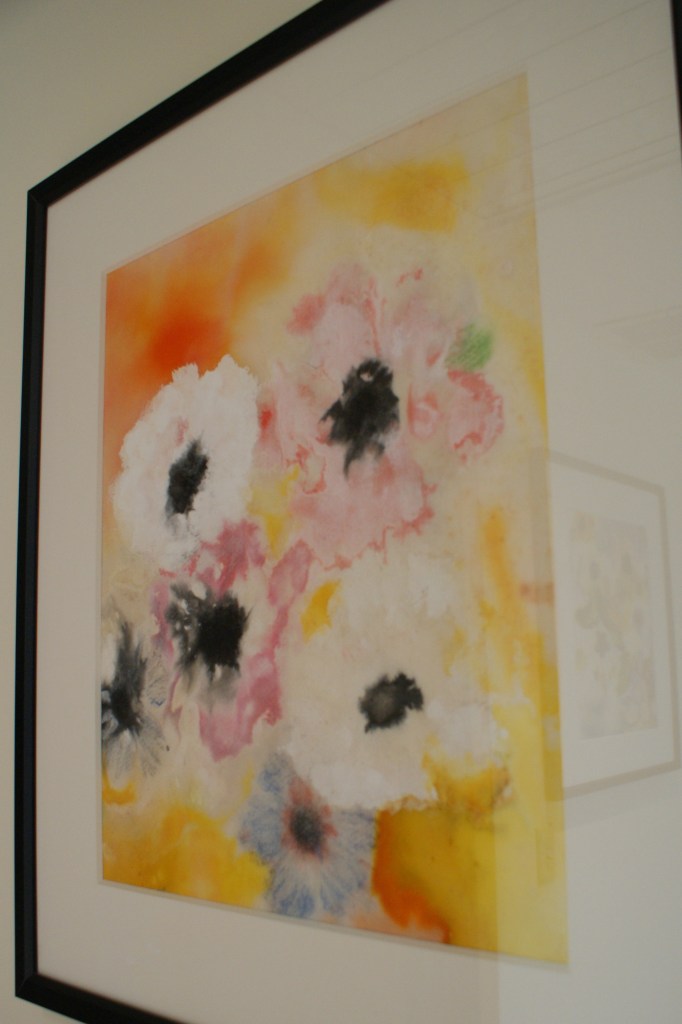
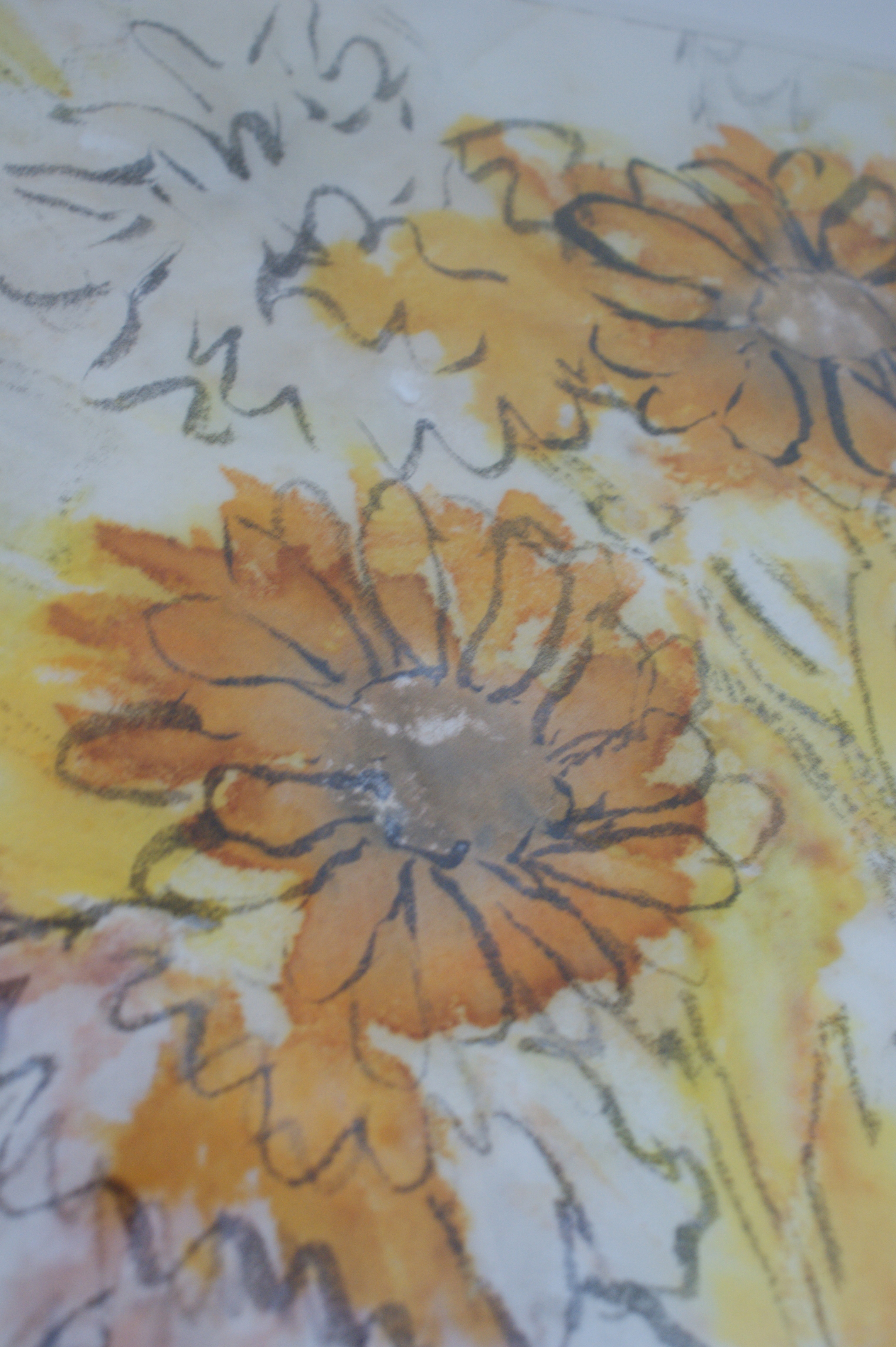
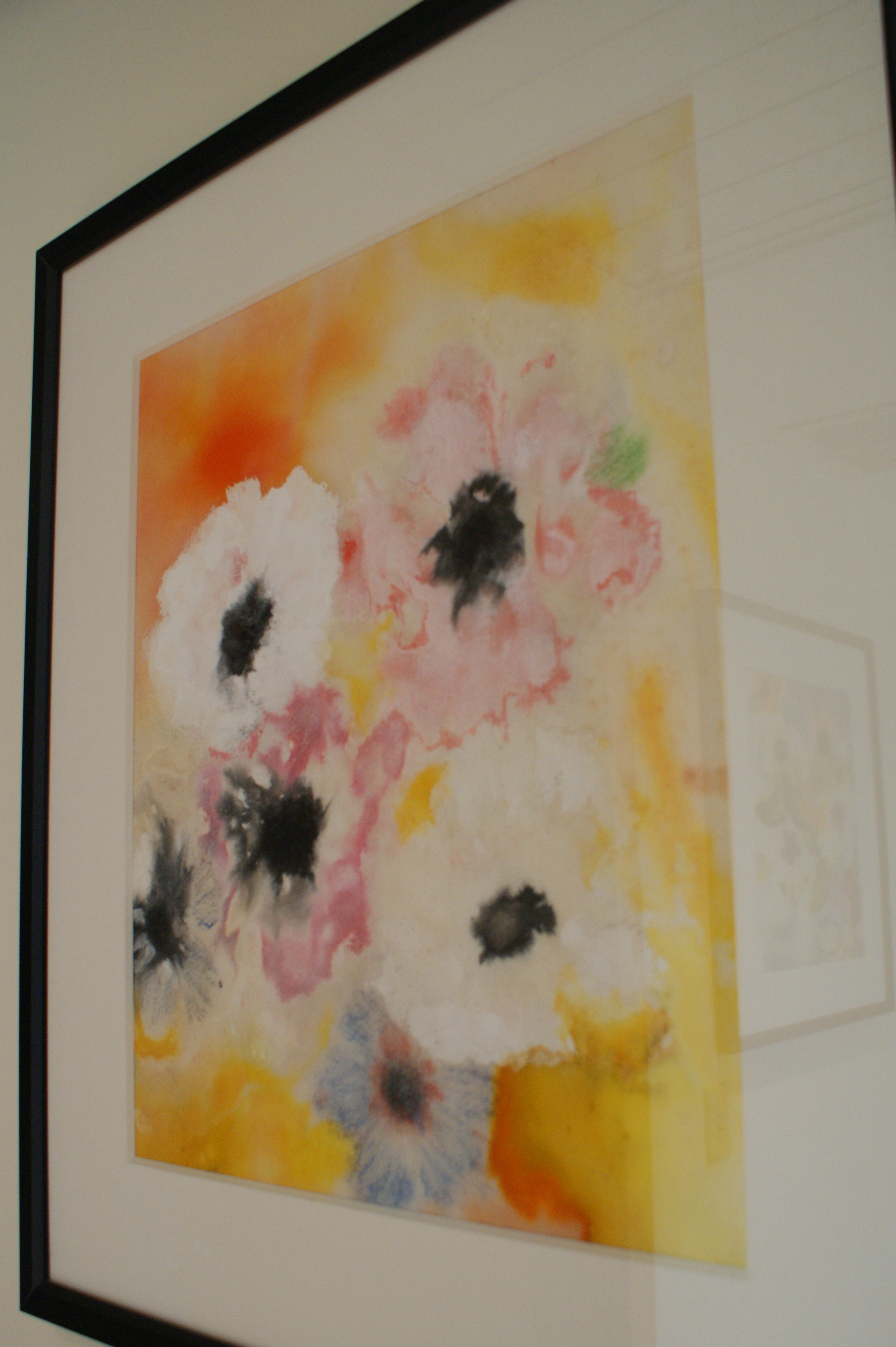
Watching the van one morning I remember thinking, “This is a kind of life I know nothing about.”  And later that morning on the train to Boston I recalled my Aunt Billie, who, in a previous generation’s vernacular, “was a little slow.”  The family talked about how Billie had gone to some of the same schools as Rosemary Kennedy, a remark whose significance was lost on me at the time.  Billie lived with our family for a brief time (a summer, maybe?) during which I worshiped her as she made fabulous art on our dining room table.  I was probably 8 or 9, and it never occurred to me to treat her any differently or feel that her faculties were diminished.  She made beautiful ink and paint designs on fabric interfacing – gorgeous flowers in vibrant colors that spread deliciously through the fibers.  Our mother had them framed and put them up all over the house.

When Aunt Billie died from kidney problems in her late 40s. I was 11 years old and the only one who got to attend the funeral in Philadelphia with my mother, and I was allowed to choose from among her things something to remember her by.  I don’t recall seeing any painting among her few things, so I chose a small needlepoint of a butterfly and her clock radio.  (In 1974, a clock radio was a big deal.)  I knew my connection to Billie was special, but I didn’t much think about how or why.  I loved the attention she gave me; she was an artist and I wanted to be one, that was all.

I still have the needlepoint tucked away somewhere, but better yet I now have several of her paintings.  A few years ago we were redecorating our upstairs and I decided to have some of them reframed – the faded dark mats and speckled antiqued wood frames were decades out of date and didn’t seem to match the art.  At the framers I chose thick white beveled mats and simple black frames, and I asked the framer to remove one painting from the old frame so we could see how it would look when it was finished.  It was then that I saw that the previous framers had backed the paintings with brown kraft paper, which, for all these years, had shone through the translucent interfacing and muddied the pigments.  When we backed the art with white paper the true colors burst forth.

All of those years, muted and misunderstood, Aunt Billie’s art was there for us to see but not in the colors she had intended.  Mom had done her best to give Billie all she needed, a place to live, the tools and a place for her artistic expression, but still the world couldn’t wholly appreciate her gift because she lived and worked on the periphery.  And as I grew up I didn’t notice the difference between the bright paintings on the table and the ones muted by the brown paper backing; I don’t think anyone did.  By then I knew what it meant to be in the same school as Rosemary Kennedy and had blindly accepted that the margins of society were okay for some kinds of people.

Now the school van comes to my house and the art is by my child, and we are doing everything we can to stay engaged in our community and steer clear of the margins.  We go to the public school and advocate for a program that is supportive and inclusive to the greatest and most practical extent.  Often it’s difficult – the margins are quiet and there are some people who need the space to be there.  But the decision has to be ours; we have the right to choose where we will be happy and how we want to belong.  And as we go, we will learn and we will show the people whose vision is obscured by the brown paper how they can remove those old dull perceptions so that they can appreciate what our true colors are.